
Quantum photonics in disordered nanostructures
After completing my PhD at the Instituto de Ciencia de Materiales de Madrid, I obtained postdoctoral positions at the Technical University of Denmark and at the Niels Bohr Institute under the supervision of Prof. Peter Lodahl, a leading expert in quantum photonics. There, I studied the role of fabrication imperfections in nanophotonic structures widely used for quantum optics experiments, in particular photonic-crystal waveguides and photonic crystals, focusing on light emission at the single-photon level.
These nanostructures are fabricated by etching nanometer-scale holes in high-refractive-index semiconductor membranes (GaAs) using electron-beam lithography. A photonic crystal consists of a triangular lattice of air holes etched into a dielectric slab, which creates a photonic bandgap where light propagation is forbidden and confinement is achieved by total internal reflection. A photonic-crystal waveguide is formed by omitting a row of holes from the lattice.
One of the most remarkable features of these systems is that they are fully compatible with self-assembled semiconductor quantum emitters, such as InAs quantum dots or quantum wells, which can be embedded directly in the membrane. Scanning electron micrographs of representative structures are shown in Fig. (a) and (c). My main goal during this period was to understand how fabrication disorder modifies light–matter interaction and to explore disorder as a resource rather than a nuisance.
Quantum photonics in disordered nanostructures
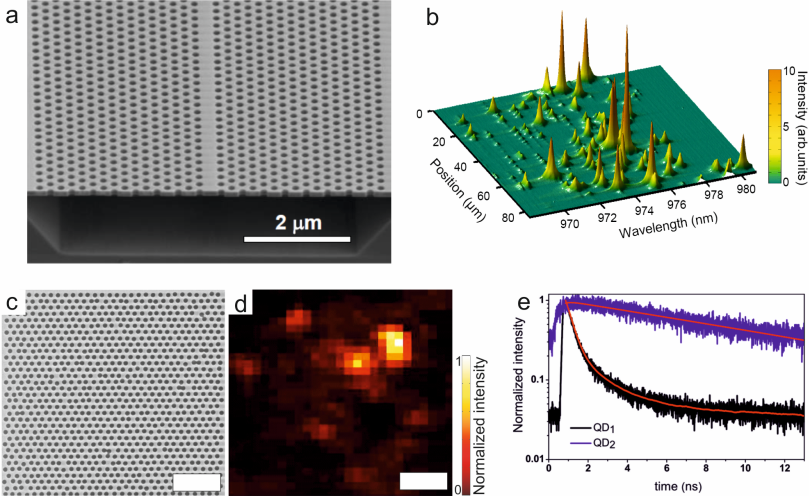
(a) Top-view scanning electron micrograph of a photonic-crystal waveguide fabricated in a GaAs membrane by omitting a row of holes. A layer of self-assembled InAs quantum dots is embedded in the center of the membrane.
(b) Structural disorder induces multiple scattering and interference, breaking the ideal guided mode into a chain of random cavities along the waveguide. Quantum-dot emission feeds these disorder-induced modes when optically excited.
(c) Top-view scanning electron micrograph of a disordered photonic crystal. Scale bar: 1 µm.
(d) Photoluminescence map collected at (905 ± 1) nm while scanning the structure.
(e) Time-resolved decay curves for two quantum dots emitting at the same wavelength but located at different positions relative to a localized mode. The decay rate of QD1 is enhanced by a factor of 114 compared to QD2 due to its coupling to the disorder-induced cavity.
Images adapted from Science 327, 1352 (2010) and Phys. Rev. Lett. 109, 253902 (2012).
Unavoidable imperfections in nanofabrication lead to random multiple scattering of light, giving rise to strong interference effects that confine light in extremely small volumes. This disorder-induced localization is known as Anderson localization, originally proposed for electrons in disordered solids.
The resulting Anderson-localized optical modes are promising for cavity quantum electrodynamics (QED), where the radiative emission rate of single quantum emitters can be strongly modified when they are spectrally and spatially matched to one of these random cavities. This effect has been demonstrated both in photonic-crystal waveguides and in disordered photonic crystals.
In our experiments, the localized cavities are revealed by embedding InAs quantum dots in the structures and exciting them under high-power illumination. The emitted photoluminescence feeds the disorder-induced modes, which can be mapped by scanning the sample. When the position and emission frequency of a single quantum dot coincide with a localized cavity, a strong enhancement of the spontaneous emission rate is observed, as shown in Fig. (e).
These results demonstrate that unavoidable disorder can be harnessed as an efficient resource for confining light in nanophotonic structures, opening new routes to all-solid-state cavity QED. Exploring disorder to enhance light–matter interaction, and understanding the fundamental limits of this approach, provide exciting opportunities not only for quantum optics but also for fields such as energy harvesting and biosensing.
Looking forward, coupling several disorder-induced cavities is a promising route to scale cavity QED systems for quantum information technologies. Controlled disorder may enable coherent coupling through so-called necklace states, which naturally emerge from chains of Anderson-localized modes.