
Topological photonics
The field of topological photonics has emerged with the promise of reducing — or even eliminating — the impact of fabrication imperfections in photonic nanostructures. The underlying idea is that the topology of a system should remain unchanged under small perturbations, and fabrication disorder is precisely such a perturbation. Engineering photonic nanostructures with distinct topological phases therefore offers a route to devices that are intrinsically more robust.
However, it is still not fully clear how these phases should be implemented in photonic systems, or how much protection they truly provide. Our approach is to translate concepts from condensed-matter physics — where topology is deeply linked to intrinsic electronic properties such as spin and valley degrees of freedom — into the photonic domain as bosonic analogues. While this translation is promising, it must be carried out carefully and quantified, since photons and phonons do not share the same fundamental symmetries as electrons.
Fig. 1. Topological protection in a photonic crystal waveguide
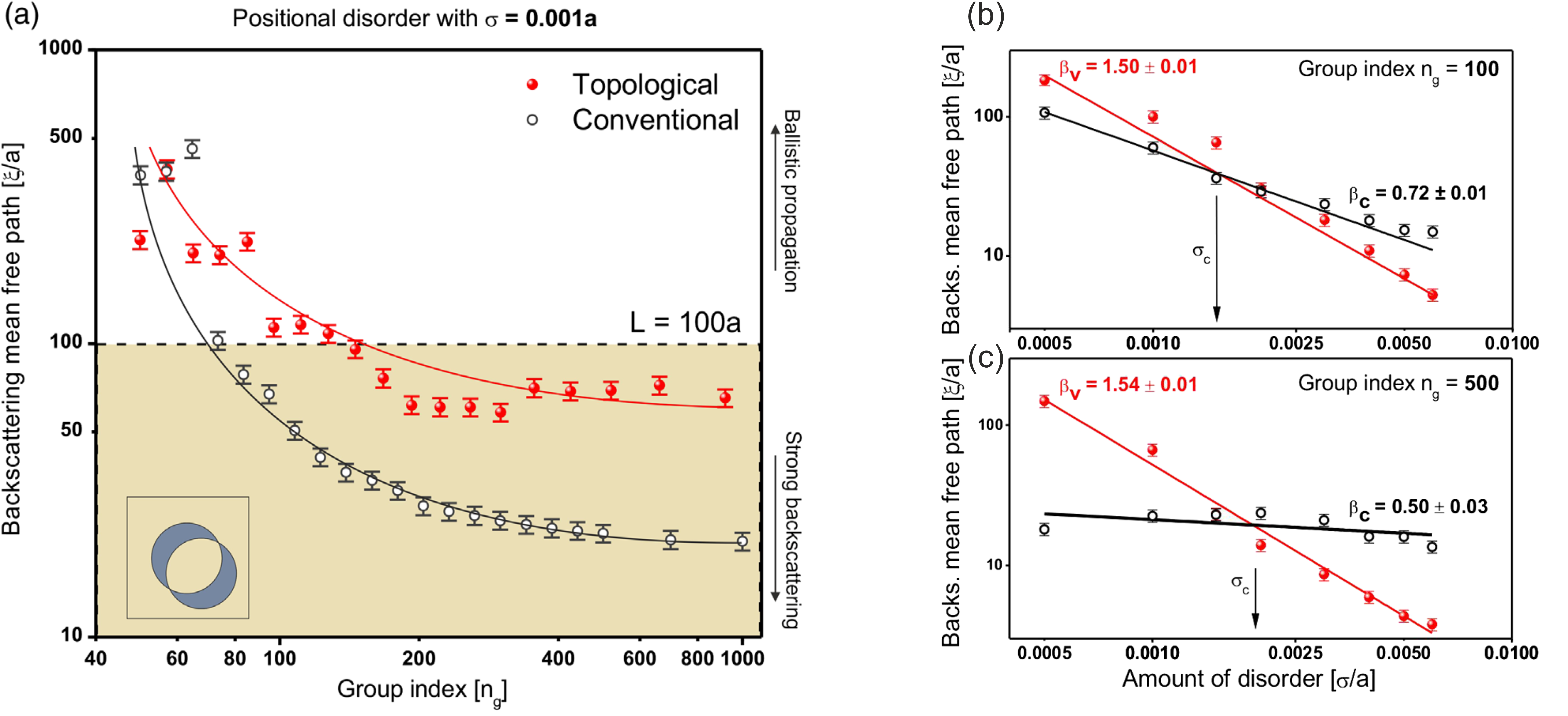
During the pandemic, I became particularly interested in the real degree of protection offered by topological designs in a system I had studied extensively: a photonic-crystal waveguide. We explore different topological phases by engineering the unit cell of periodic structures, where band-symmetry inversion through geometry is the key mechanism.
Our central question is: how robust are topological analogies from solid-state physics when applied to bosonic systems such as light and mechanical vibrations? To address this, we developed a quantitative framework to evaluate robustness against structural disorder.
Specifically, we calculate the backscattering mean free path and relate it to the group index through the density of optical states. This allows us to directly compare topological and conventional waveguides fabricated with the same level of disorder.
By measuring the structural imperfections (as shown in panels (b) and (c) of the figure) and correlating them with transport properties, we demonstrate that photonic topological phases based on parity-symmetry breaking (such as the valley-Hall effect) are quantitatively more robust — by almost a factor of five — than standard waveguides for small disorder levels. However, this advantage gradually disappears as the amount of imperfection increases.
These results show that topology in photonics is not absolute protection, but rather a measurable enhancement of robustness whose limits can and must be quantified.